UK HE online student trends 2024/25: Analysis of the latest HESA data
After several years of turbulence in the release of HESA student data for UK higher education, it feels as though things are starting to get back on an even keel. Data for the 2024-25 academic year was released at the end of January 2026, as it had been for many years prior to a recent period of reporting changes. This means that although the data is still retrospective, there is less distance between reporting and publishing.
This HESA data release provides the best insight into online student enrolment trends in UK higher education and the relative performance of UK universities and other higher education providers operating in online undergraduate and postgraduate degree markets. It is worth noting that the data is not perfect, and we should not blindly trust it, nor should we expect time series analysis to be as robust as we might like, particularly in recent years when reporting errors have skewed overall numbers.
Nevertheless, there is a great deal that is useful within this data and plenty to reflect upon when considering the UK online student market at both undergraduate degree and postgraduate taught level. On that point, it is worth stating clearly that this analysis excludes international students entirely and focuses only on UK-domiciled students studying online at undergraduate degree and postgraduate taught level. An analysis of international online students will follow. I will look at these two student markets in turn, starting with undergraduate degrees.
UK online undergraduate degree students: 2024/25 HESA trends
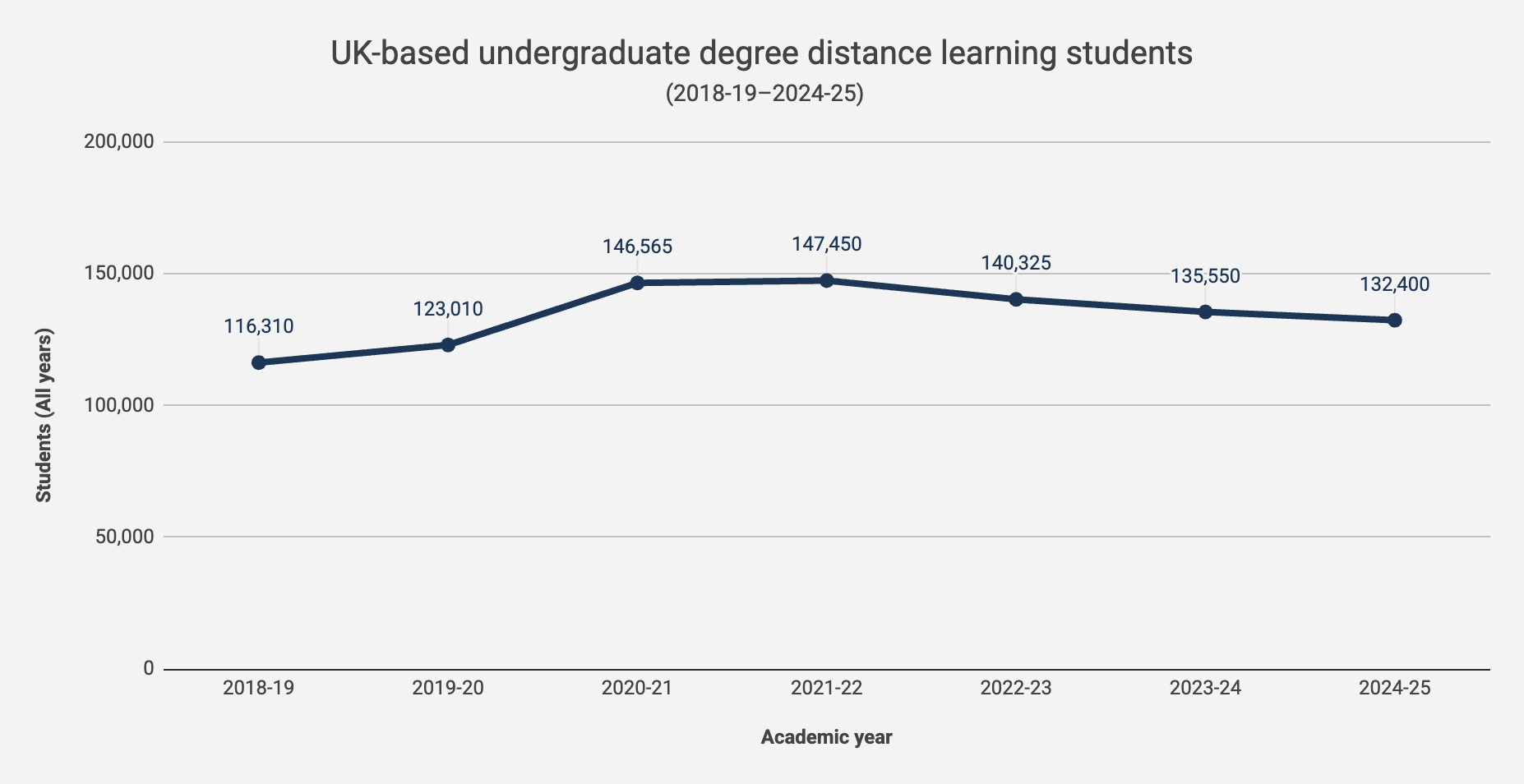
The 24-25 HESA data shows a slight decline of 2% (3,150 students) in the overall number of UK-domiciled distance learning students studying for undergraduate degrees. This continues a downward trend from the peaks of 2020-21 and 2021-22, when the pandemic exerted a significant influence on enrolments.
Although annual declines have been recorded over the last three years of reporting, the overall number of students in 2024-25 remains significantly higher than pre-pandemic levels. In addition, the decline this year is smaller than in 2023-24 (3.4 per cent) and in 2022-23 (4.8 per cent).
Looking at aggregated data is necessary to provide a high-level picture of enrolments, but for undergraduate distance learning students in UK higher education, I would argue that this figure is one of the most misleading in the sector. Critical information is always lost when data is aggregated, and this is particularly true of undergraduate distance learning student data.
There are a few main reasons for this. Firstly, the reporting does not solely capture students studying on bona fide online degrees, but also includes those enrolled on degree apprenticeships. For example, apprenticeship provider Multiverse has been recording growing numbers of students who fall into this category.
Secondly, the Open University accounts for 78 per cent of all students in this group, which significantly obscures the broader picture across UK universities. For these reasons, if you want to understand the online undergraduate degree student market properly, you need to delve much deeper than these headline figures.
When doing so, what we find this year is that the single most important factor driving the overall decline is the Open University. It reported a fall of 4,400 students compared with 2023-24. While other universities did report declines, they are dwarfed by the scale of the reduction at the Open University. As a result, those looking at the aggregate total as evidence of the health, or otherwise, of online undergraduate enrolments in UK higher education should tread very carefully.
Online undergraduate degrees by provider
The most important insights from this data can be found by investigating it at provider level, but this also needs to be triangulated with data on the undergraduate degree product market. As this is already an area of research and market analysis for me, I am able to use this combination of data points to provide a more rounded analysis.
In previous years, I have simply highlighted the higher education (HE) providers that reported the highest numbers of distance learning undergraduate degree students to HESA. However, the problem with this approach is that it does not provide a wholly accurate representation of those that are key players in this student market landscape.
This year, I’ve chosen to be more selective and to highlight the top HE providers based on criteria such as their number of online students and enrolment growth, the breadth and range of their online degrees, the length of time they have operated in this market, and their clear strategic focus on online undergraduate degrees.
This is in contrast to simply identifying those that have recorded the largest numbers. This leads to the following universities, which in my estimation are the most significant players in the online undergraduate degree market in UK higher education at present.
Top UK universities by number of UK online undergraduate degree students
Open University - 103,180
Arden University - 5,170
University of Derby - 2,785
University of London - 1,485
Robert Gordon University - 1,295
University of Essex Online - 780
University of Portsmouth - 735
Falmouth University - 635
Anglia Ruskin University - 445
In reality, there are so few UK universities that are seriously and strategically invested in online undergraduate degree provision that there are only a couple that could feasibly be added to this list. To understand the landscape and to gain genuinely useful insights into the UK domestic undergraduate student market, it is therefore important to look more closely at some of these providers.
As mentioned earlier, the biggest story in this data is the decline in student numbers at the Open University (OU), which have fallen from approximately 122,000 in 2021-22 to 103,180 in 2024-25. It is worth noting that the OU still looms very large in this market and recorded over 30,000 new undergraduate degree students in 2024-25. So we are still talking about a very large institution in UK higher education terms, recruiting significant numbers of students each year.
To an extent, then, these student numbers need to be judged against what the institution itself is saying, and that is perhaps the most telling factor. In its 2025 financial report, the OU stated that “performance for taught student recruitment was below the anticipated level”, which suggests that rather than this decline being a managed reduction from pandemic-era highs, the institution has missed its enrolment targets. As the OU has stated in this and other reports, its market share, while still large, is declining.
However, the thing I find most concerning in this reporting, is not the failure to meet enrolment targets but the narratives around marketing performance that accompany it. Statements such as “Brand familiarity, consideration and recognition among UK adults are at record levels, supported by multi-channel marketing campaigns that reach 97 per cent of the UK adult population” sit uncomfortably alongside missed enrolment targets.
It is difficult to argue that improving brand metrics alongside deteriorating outcomes is clear evidence of marketing effectiveness. Whether or not this is the case in practice, it projects an organisation that may be measuring the wrong things, with marketing drifting from an enrolment-focused function towards a reassurance-driven one.
When looking beyond the OU, its still sizeable share of the market continues to obscure wider patterns. For this reason, one useful approach is to look at total enrolments by year excluding the OU. What this shows is a small but steadily increasing number of online undergraduate students across all other institutions.

One of the universities that is undoubtedly presenting the most significant challenge as the most rapidly growing provider in this space is the private university Arden University. It has seen notable growth in UK student numbers and in 2024-25 recorded over 5,000 online undergraduate degree students for the first time.
Two other universities worth mentioning here that reported increases are the University of Derby and Falmouth University. Both of these institutions have been significantly invested in online provision for many years, and this is now evident in their online undergraduate and postgraduate student numbers.
Overall, the data shows that a decline at the Open University is obscuring some growth, albeit modest in scale, across a number of other universities, most notably those that are strategically and seriously invested in online undergraduate degree provision and have been for several years.
UK online postgraduate degree students: 2024/25 HESA trends
In the UK higher education online student landscape, the postgraduate degree market is paradoxically more significant, despite overall student numbers being smaller than at undergraduate level.
Postgraduate degrees have traditionally been more closely aligned with audiences seeking flexible study options and, as a result, this is the market with the greatest number of online degrees and the largest number of UK HE providers strategically invested in them. Another reason for its greater significance is that the number of UK online postgraduate students has grown significantly in recent years, while on-campus UK student numbers have declined.
I sometimes argue that if it were not for the substantial increase in international on-campus student numbers prior to government policy changes, the rise in UK students choosing to study postgraduate degrees online would be a more prominent sector-wide story.
This growth has continued in the current reporting cycle, with the number of UK-domiciled distance learning postgraduate students increasing marginally again to 94,825 in 2024-25. This is despite a decrease of 1 per cent in total UK postgraduate student numbers overall.
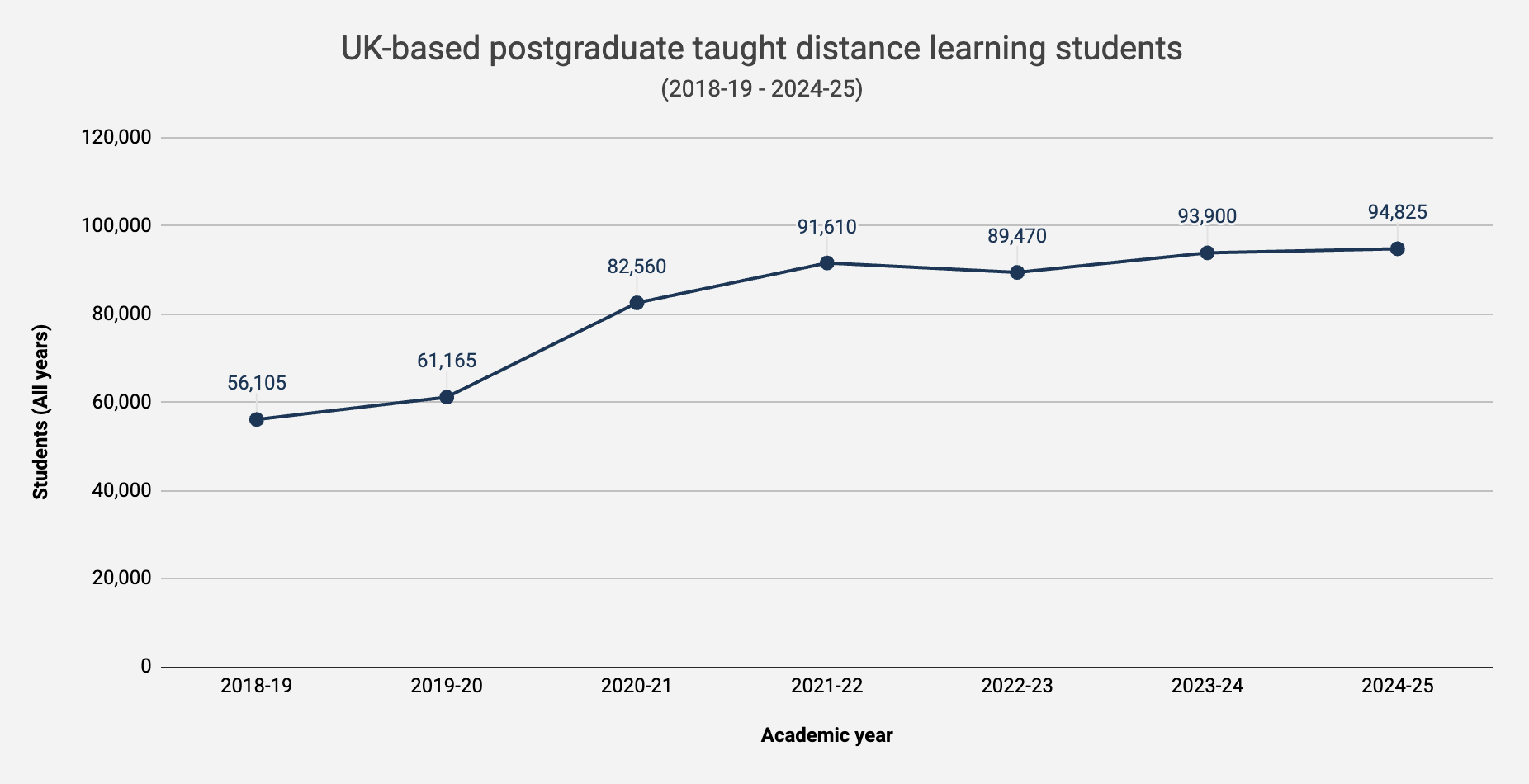
Another interesting aspect of this is that while the number of UK-based online postgraduate taught students has been steadily growing, on-campus numbers have been in decline. They have fallen from 302,905 in 2020-21 to 241,240 in 2024-25.
At this point, it is worth reiterating that these figures do not include international students, as it has been international enrolments that have driven widely reported increases in on-campus postgraduate taught numbers, while the only growth among UK-based students in recent years has been concentrated in online education.
Online postgraduate degrees by provider
When looking at provider-level UK online student numbers, a few things stand out. First, there are some similarities with my earlier reporting, as the Open University recorded the largest decline in overall UK online postgraduate taught student numbers, registering a drop of 1,455. In contrast, Arden University recorded one of the largest increases, with growth of over 1,000 students in 2024/25.
Outside of these two providers, significant declines have been recorded at a number of Scottish universities, including Robert Gordon University, the University of Aberdeen, the University of Edinburgh and the University of Glasgow.
These declines vary in scale and, while in some cases they are likely to be linked to performance-related factors, one of the most significant drivers is likely to be the Scottish Government’s decision to discontinue the Upskilling Fund. This fund supported universities to offer flexible opportunities for people to upskill or reskill in specific curriculum areas, and several Scottish universities had hundreds of online students enrolled on courses supported by it. It is highly likely that the end of this scheme has played a significant role in some of the online student declines reported.
Beyond these Scottish universities, both the University of Warwick and Northumbria University recorded notable declines of over 500 students each.
This year, 33 HE providers recorded student number increases of 100 or more. As noted earlier, Arden University is the most prominent example, but two others worth highlighting that recorded growth of over 700 students are the University of Exeter and Queen Margaret University. The latter entered into an OPM partnership, and this is the first reporting cycle in which the impact of that decision is reflected in the HESA return.
As with the UK online undergraduate market, it is more accurate to identify leading providers through a selective approach rather than simply listing those with the highest recorded numbers.
The following is my selection of the current top ten providers, based on criteria such as total online student numbers and enrolment growth, the breadth and range of their online degrees, the length of time they have operated in this market, and their clear strategic focus on online postgraduate degrees.
Top UK universities by number of UK online postgraduate degree students
Open University - 6,290
University of Law - 4,225
Arden University - 3,635
University of Wolverhampton - 2,910
King’s College London - 2,330
University of Birmingham - 1,990
Anglia Ruskin University - 1,795
University of Hull - 1,785
University of Strathclyde - 1,745
University of Edinburgh - 1,710
Overall, this latest data release supports a view of the UK online postgraduate taught student market as stable, with incremental growth. It is a market that continues to present opportunities for HE providers with effective online education operations and strategies to grow and sustain student numbers.
However, it has become far more competitive than several years ago, which can perhaps best be illustrated by the fact that in 2017/18 there were only ten providers with over 1,000 online postgraduate taught students, whereas in 2024/25 there were 32.
This helps to explain the mixed picture for HE providers invested in online postgraduate degree portfolios. While a small number have experienced either significant enrolment gains or declines, there is a much larger group for whom year-on-year gains or losses are neither substantial nor particularly significant.
Strategies and operations are becoming increasingly important in achieving sustainable levels of recruitment in a more competitive landscape. Whether this relates to OPM-partnered operations that have become overly formulaic, or universities that may have chugged along offering PGT provision with limited investment and prioritisation, there is significant scope across the sector to develop more effective strategies, stronger operations, and to become far more differentiated and commercially savvy than they currently are.
Overall reflections on UK online student enrolments
What this year’s data reinforces is the story of online student enrolment over the last ten years, which, outside of the pandemic years, has been one of steady, incremental growth. While both undergraduate and postgraduate student numbers have fluctuated, the trend line for each remains upwards, albeit at different rates.
Although both student markets have increased, they have not done so at a level that can support all institutions now operating in the market to comfortably recruit the numbers of students they would like. Pressures are clearly being felt across different institutional contexts.
Some institutions that have operated in the online education market for many years are increasingly facing challenges because they never truly invested in online education or developed effective strategies. At the other end of the spectrum are university operations in partnership with OPMs which, while benefiting from greater investment and capability, are not always delivering the desired outcomes either. There are a range of factors contributing to this.
Taken together, the message from this data is that if you are serious about online education, there is scope to grow and sustain enrolments, but if you are not, then, unless you are very fortunate, this will be challenging.
Being serious does not necessarily mean investing significant sums of money, although that becomes a stronger consideration as levels of ambition increase. Seriousness can also be demonstrated through developing a sound competitive strategy for operating in these markets, even when constraints are high and budgets are tight. Regardless of whether an institution is large or small, it is the absence of such strategies that I regularly see as one of the biggest hindrances to overall performance.